 |
Alan's
and Sheila's Homepage
|
|
 |
Astrophotography... |
|
The art of quality amateur astrophotography takes years to
master and requires relatively expensive equipment, particularly
the telescope mount, tracking drive and guiding apparatus, all
of which must work in concert to allow the telescope to perfectly
track its target for long periods of time without even the slightest
vibration. It also requires great skill and patience as well
as an almost sublime knowledge of film emulsions and developing
techniques. Finally, it requires photographing from a very dark
site far away from city lights on a clear night and even then
there are relatively few nights when upper atmosphere air disturbances
are at a minimum.
My telescope, a Celestron C5+ Schmidt-Cassegrain telescope,
and its mount are not quite up to the challenge. Nor do I yet
have the skill or experience, let alone access to a dark site.
Nevertheless, these photographs represent my first attempts at
astrophotography. They are embarrassingly poor in comparison
to the quality astrophotographs that many amateurs can capture.
(see below)
Click on any photo to enlarge.
Lunar Photos:
|
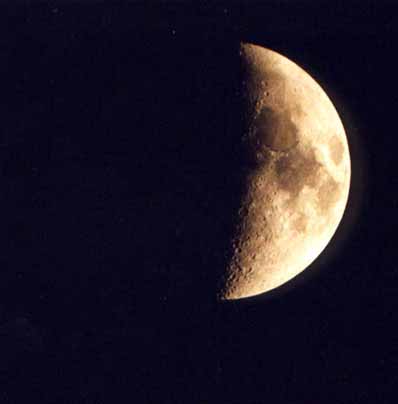
Half Moon |
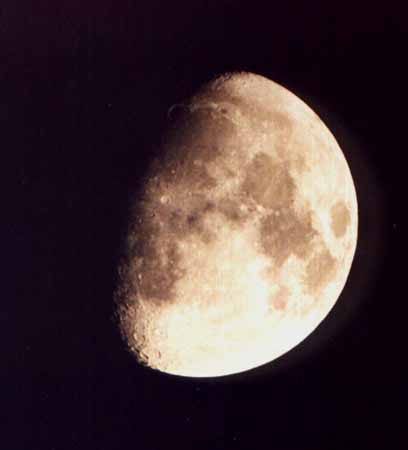
Three Quarter Moon |

Full Moon |

Fully Eclipsed Moon |
Lunar images taken at prime focus (camera
attached to the back of the telescope without an eyepiece -1250mm,
f/10) on Fuji X-tra 800 speed film and exposed for 1/125, 1/250,
1/500 and 4 seconds respectively. Because the moon is so large
and bright, its capture on film is trivial, not requiring any
tracking.
|

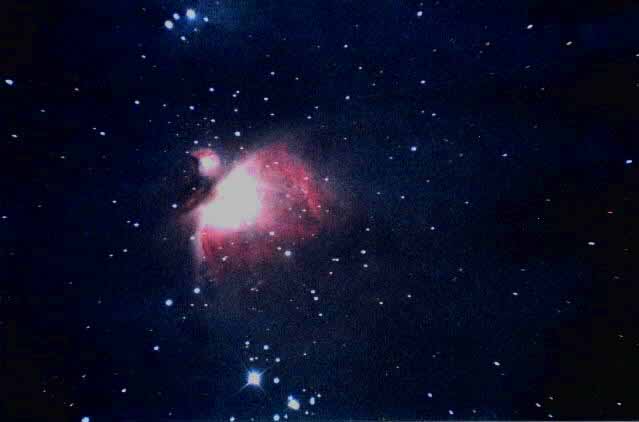
Orion Nebula-M42
This is an image of the Great Orion Nebula
(M42) taken from my backyard. This incredible nebula appears
as the middle star of the sword in the constellation Orion. The
image was exposed for 5 minutes on Fuji X-tra 800 speed film.
The image was shot trough the telscope at prime focus (1250mm,
f/10). The nebulosity and quality of the image is severely limited
by sky glow (ambient city light). On a positive note, the background
stars are round which meant that my rough polar alignment was
fairly accurate. (The telescope mount has a motor which moves
the optical tube assembly in such a manner as to counteract the
rotation of the earth. To acheive polar alignment, the polar
axis of the mount must be aligned with the earth's polar axis.) |
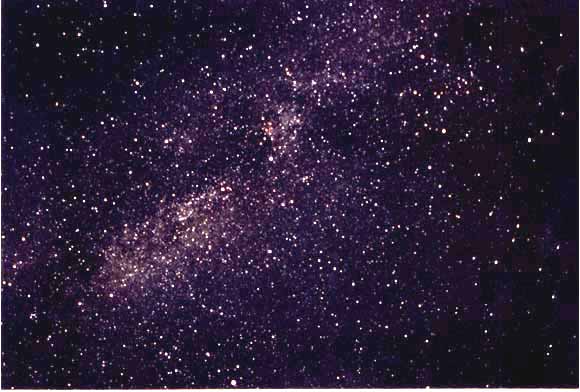
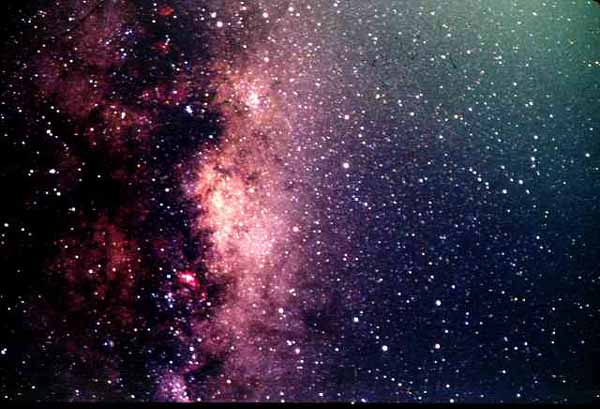
The Milky Way
This is an image of the Milky Way in September
taken about 20 miles West of Ft. Worth. The Milky Way, the name
of our galaxy, also refers to the dense band of stars corresponding
to the portion of the sky aligned with the galactic plane. This
photo was exposed for about 4 minutes on Fuji X-tra 800 speed
film with the camera mounted piggyback on the telescope. The
image was taken through the camera lens (Canon EF 28-105 USM)
which was set to its widest angle focal length and largest apteture,
i.e 28mm at f/3.5 |
Gene Slape's Astrophotography
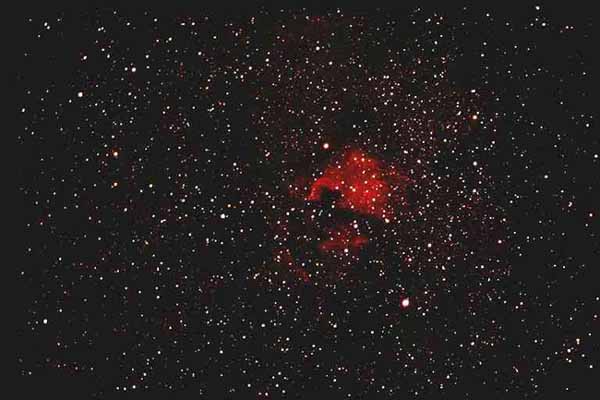
To demonstrate what equipment comparable to
mine can accomplish with more practice and skill, here are some
astrophotographs taken by my friend Gene Slape. Gene took these
from fairly dark sites away from city lights in Texas. They are
excellent given the limitation of the caliber of equipment that
we have.
|
Orion Nebula - M42 |
Sagittarius Region |
North American Nebula |
The Best Amateurs -
Turn lights off for the
most impressive viewing !!!
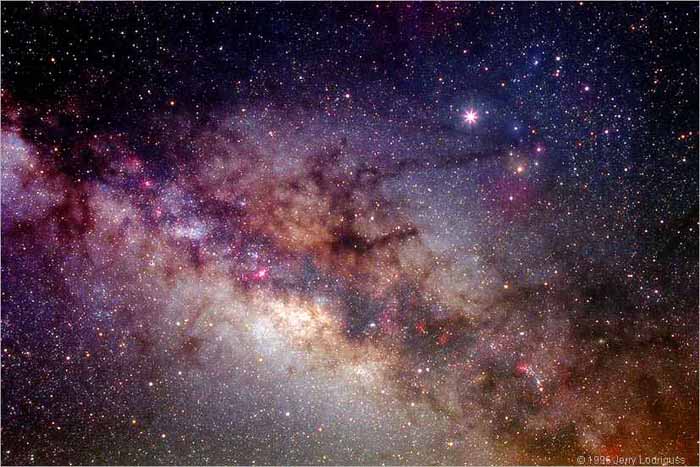
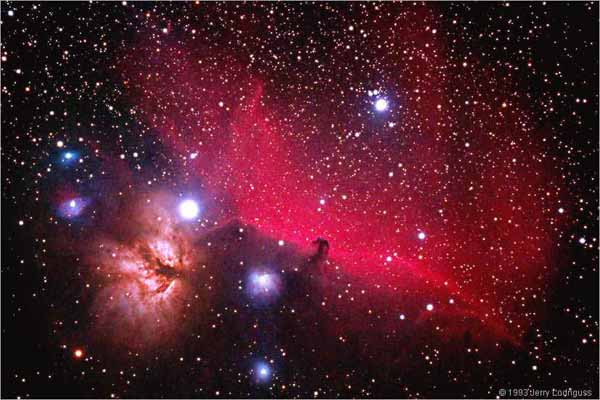
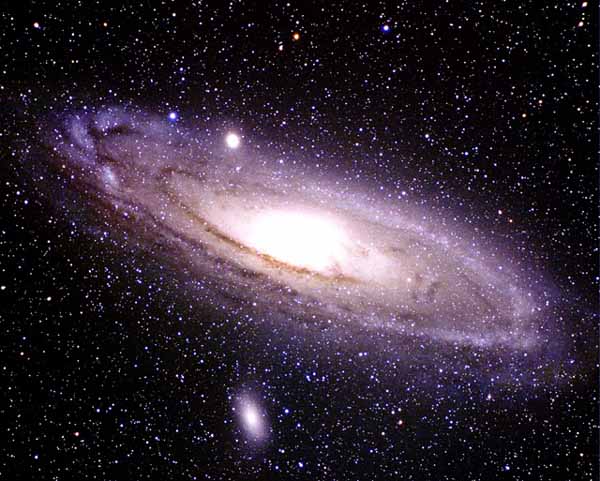
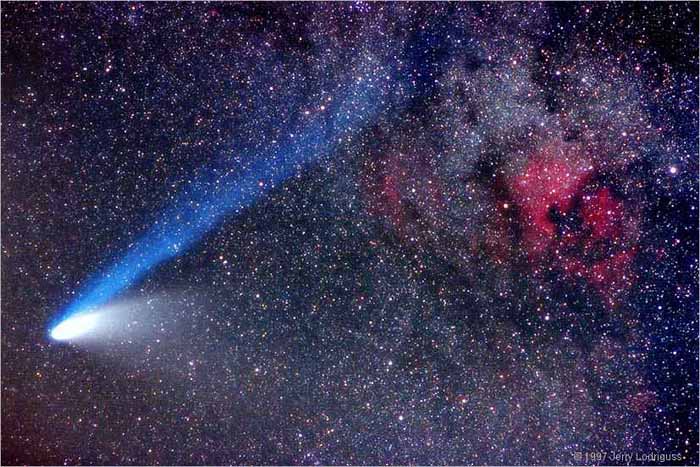
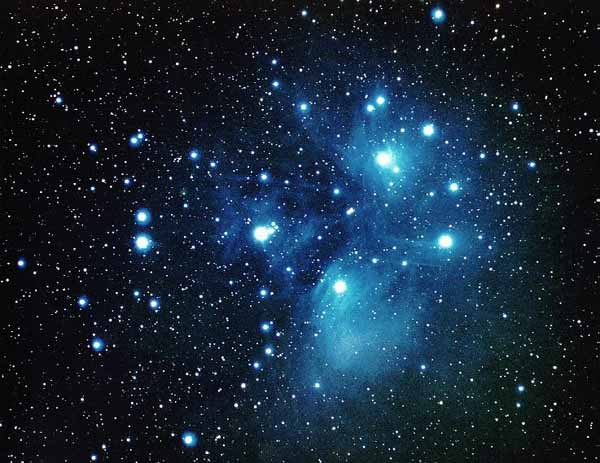
Finally, here is a sampling of what the best
amateurs can accomplish. It is hard to believe that these outstanding
photographs can be taken by amateur astronomers using store bought
(albeit high end) telescopes, mounts and cameras.
|

Orion Nebula - M42 |
Sagittarius Region |
The Horshead Nebula |
|
The Andromeda Galaxy - M31 |
Hale-Bopp Comet |
The Pleiades - M45 |
The amazing thing to keep in mind is that
these objects do not require large magnification to see. The
objects in these images are not magnified much more than the
equivalent of a decent pair of binoculars. However, these objects
are extremely dim, so that we cannot see them. The telescope's
primary job is to make them brighter not larger, but even then
it takes 30-90 minutes of continuous exposure on specialized
film to allow the colors and detail to collect.
The photos above were taken by Jerry Lodigruss
and Jason Ware , two of best of the dozens of execellent ameteur
astrophotographers that can be found on the web. Here are their
websites:
|
|


